The Navadurgā and the Ninefold Manifestation
- Ajayh Zharotia

- Oct 1, 2025
- 10 min read
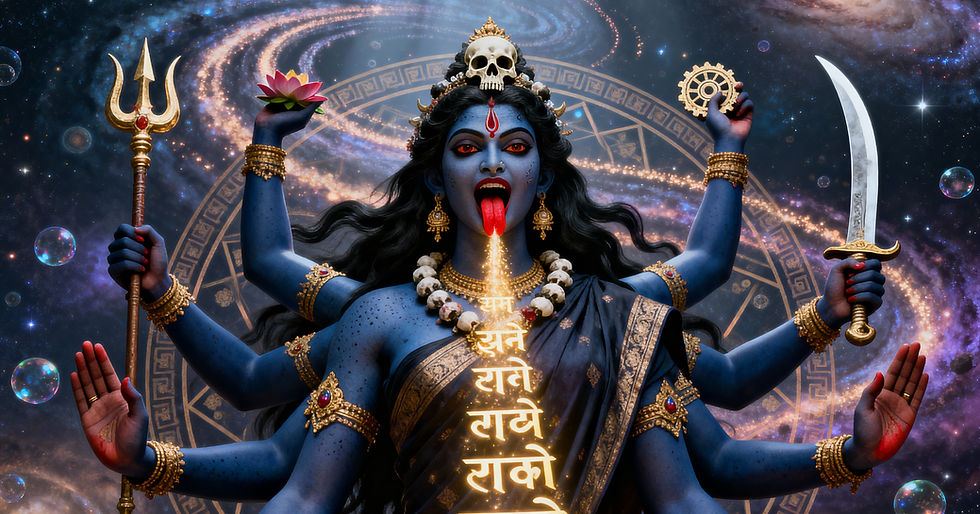
Introduction: Two Ninefold Mysteries
The profound correlation is not only possible but reveals deep layers of tantric wisdom when we align the nine forms of Durgā (Navadurgā) worshipped during Navarātri with the ninefold sound-consciousness manifestation. Both represent complete cosmological cycles, both trace the Divine Mother's creative descent and transformative ascent, and both encode the full spectrum of Her powers.
However, we must approach this with nuance. The Navadurgā tradition has variations—some lineages worship nine forms during the nine nights, others focus on different groupings. The most widely recognized Navadurgā are those worshipped sequentially during Navarātri, representing the Goddess's progressive manifestations from terrifying power to benevolent grace.
Let me present a correlation that honors both the philosophical depth of the sound-manifestation teaching and the devotional-yogic significance of the Navadurgā forms.
The Correlation Framework
Understanding the Direction
The ninefold sound manifestation describes descent—from supreme consciousness (Parā) downward to gross speech (Vaikharī). The Navadurgā, as worshipped during Navarātri, describe both descent AND ascent—the Goddess comes down into manifestation to destroy ignorance, then uplifts the devotee back to divine consciousness.
Therefore, we can map the correlation in two ways:
Cosmological order: Following the descent of consciousness into manifestation
Devotional order: Following the nine nights of Navarātri worship
Following is the Complete Descent Pattern. Reading the correlation sequentially:
Śailaputrī - Pure "I AM" consciousness emerges (Vimarśa)
Brahmacāriṇī - Energy concentrates into focused potential (Bindu)
Candraghaṇṭā - First vibration sounds, the cosmic bell rings (Nāda)
Kūṣmāṇḍā - Creation bursts forth with cosmic laughter (Sphoṭa)
Skandamātā - Subtle sound-forms take shape (Śabda)
Kātyāyanī - Supreme unified speech-power (Parā Vāk)
Kālarātri - Visionary darkness where archetypes exist (Paśyantī Vāk)
Mahāgaurī - Clear mental thought emerges (Madhyamā Vāk)
Siddhidātrī - Perfect physical manifestation (Vaikharī Vāk)
I will present both, as they illuminate different aspects of the teaching.

Correlation One: The Cosmological Descent
1. Śailaputrī (शैलपुत्री) - Daughter of the Mountain
Correlates with: Vimarśa (Pure Self-Reflective Consciousness)
Śailaputrī represents the Goddess in her most primordial form, just born from the mountain (Himālaya, representing the transcendent). She holds a trident and lotus, rides a bull (Vṛṣabha—representing dharma, stability, the ground of being).
Why this correlation?
She is the first emergence of the Divine Feminine into form
The mountain represents the stable, unchanging ground—pure consciousness
Her simplicity and purity reflect the undifferentiated "I am" awareness (aham-vimarśa)
She is potential about to become kinetic
Just as Vimarśa is the first stirring of self-awareness in consciousness, Śailaputrī is the first manifestation of the Goddess
Significance: The bull she rides represents the stable witness-consciousness. The trident represents the three bindus (will, knowledge, action) about to differentiate. She is consciousness saying "I AM" for the first time.
2. Brahmacāriṇī (ब्रह्मचारिणी) - The Ascetic
Correlates with: Bindu (The Concentrated Point)
Brahmacāriṇī practices intense austerity (tapas), walks barefoot, holds a rosary and water pot. She represents concentrated spiritual energy, gathered focus, disciplined power held in reserve.
Why this correlation?
The bindu is concentrated creative potential, power compressed to a point
Her austerity represents the gathering and focusing of scattered energy
The rosary represents the concentrated mantra-power
She is energy turned inward, not yet released into manifestation
Her celibacy (brahmacarya) symbolizes undissipated śakti
Significance: Just as the bindu contains all creation in seed form, Brahmacāriṇī contains all power in disciplined concentration. Her tapas generates the heat (tapas) that will fuel creation. She is the Goddess preparing for the great work.
3. Candraghaṇṭā (चन्द्रघण्टा) - She with the Moon-Bell
Correlates with: Nāda (Primordial Vibration)
Candraghaṇṭā has a crescent moon on her forehead shaped like a bell. She rides a tiger, has ten arms with various weapons, and represents the first sound of creation—the cosmic bell that rings at the dawn of manifestation.
Why this correlation?
The bell (ghaṇṭā) represents primal sound vibration
The crescent moon symbolizes the subtle, barely visible beginning of manifestation
The ringing of the bell is the first nāda, the unstruck sound beginning to resonate
Her tiger represents the raw power of vibration—fierce, untamed energy
Ten arms represent the ten directions—vibration spreading omnidirectionally
Significance: The bell-shaped moon is extraordinarily appropriate—it links the celestial (moon/consciousness) with sound (bell). This is nāda as the cosmic announcement: "Creation begins!" The tiger she rides represents spanda—the divine throb, the primordial pulsation.
4. Kūṣmāṇḍā (कूष्माण्डा) - She Who Creates the Cosmic Egg
Correlates with: Sphoṭa (The Bursting Forth)
Kūṣmāṇḍā creates the universe with her divine smile. Her laughter generates the cosmic egg (brahmāṇḍa). She rides a lion, has eight arms, and radiates light like the sun dwelling in the solar orb.
Why this correlation?
Sphoṭa means "bursting" or "explosion"—the sudden revelation of meaning
Her smile/laughter creates the universe—a burst of creative joy
The cosmic egg is the moment of manifestation bursting forth from potential
She dwells in the sun—the source of light and revelation
Her name relates to kuṣmāṇḍa (pumpkin/gourd)—something that bursts open when ripe
Significance: This is the Big Bang of consciousness—the moment when the concentrated bindu explodes into manifestation. Her dwelling in the sun represents the illumination aspect of sphoṭa—the flash of understanding, the light bulb moment. The universe "dawns" with her smile.
5. Skandamātā (स्कन्दमाता) - Mother of Skanda
Correlates with: Śabda (Subtle Sound)
Skandamātā holds her son Skanda (Kārtikeya) in her lap while riding a lion. She has four arms and is depicted in a nurturing, motherly form. Skanda represents the seed-syllable, the germinal sound-form.
Why this correlation?
She is literally holding the seed (Skanda)—subtle sound before articulation
Skanda as the warrior-god represents concentrated mantra-power
The mother-child relationship mirrors how subtle sound "gives birth" to gross sound
She is tender yet powerful—subtle yet potent
Four arms represent the four levels of speech about to fully differentiate
Significance: Śabda is sound at its most subtle material form—still mental but with phonetic character. Skandamātā holding Skanda represents consciousness holding the seed-sound ready for manifestation. Skanda will grow up to be the commander of divine armies—mantra-power will become the force that shapes reality.
6. Kātyāyanī (कात्यायनी) - Daughter of Sage Katyāyana
Correlates with: Parā Vāk (Supreme Speech)
Kātyāyanī is a fierce warrior goddess with four arms, rides a lion, and wields a sword. She was born from the combined anger of the gods to destroy the demon Mahiṣāsura. She represents righteous fury and absolute power.
Why this correlation?
Parā Vāk is supreme, undifferentiated speech-consciousness at the Mūlādhāra
She is born from the collective will of all gods—representing unified consciousness
Her sword cuts through ignorance—Parā destroys the illusion of separation
She is the concentrated power that exists before differentiation into multiple forms
Her golden complexion represents the supreme luminosity of consciousness
Significance: This placement might seem counterintuitive since we're now at the "supreme" level while descending, but remember: the Navadurgā also represent the Goddess's descent to help humanity. Kātyāyanī represents Parā Vāk descending into the root center as pure potential power. She holds the sword of discrimination that will cut through the veils of manifestation. She is Kuṇḍalinī in her coiled, potential form.
7. Kālarātri (कालरात्रि) - The Dark Night
Correlates with: Paśyantī Vāk (Visionary Speech)
Kālarātri is the terrifying form—dark as night, disheveled hair, rides a donkey, breathes fire. She has four arms with various weapons. She represents the dissolution of ego and the dark night of the soul that precedes illumination.
Why this correlation?
Paśyantī is "seeing" speech—the visionary level where archetypes exist
The "dark night" represents the void of potentiality where visions arise
Her darkness is not evil but the pregnant darkness of the womb—the space of vision
The donkey represents the humble, slow journey through subtle perception
Her fire-breathing represents the tejas (fire element) associated with Paśyantī
She destroys fear—representing the dissolution of subject-object duality at the visionary level
Significance: Kālarātri is the Night of Time, the dark space where cosmic visions unfold. In deep meditation, practitioners often experience this darkness before visions arise. She represents the terrifying freedom of pure seeing without interpretation—reality as it is before conceptualization. The "seeing" of Paśyantī happens in this primordial darkness where all forms exist as potential.
8. Mahāgaurī (महागौरी) - The Great White Goddess
Correlates with: Madhyamā Vāk (Intermediate Speech)
Mahāgaurī is radiantly white, rides a white bull, has four arms, and represents purity and peace. She is shown as young and beautiful, often in a benevolent, calming form.
Why this correlation?
After the darkness of Kālarātri, the light emerges—from vision to thought
White represents clarity, purity of thought, mental illumination
Madhyamā is mental speech, internal dialogue—the "middle" level
The white bull represents sattva, the pure mental quality
Her beauty represents the aesthetic pleasure of clear thinking
Four arms represent structured thought—the organization of mental content
She is youthful—representing the fresh, ever-renewing nature of thought
Significance: Mahāgaurī represents the illuminated mind, where thoughts flow clearly like pure white light. This is Madhyamā—the level where we think in organized, sequential patterns. The heart center (Anāhata) is her domain, where emotion and thought meet. Her white color represents the purified mental state where consciousness has become self-aware as thinking subject.
9. Siddhidātrī (सिद्धिदात्री) - Bestower of Perfections
Correlates with: Vaikharī Vāk (Gross Speech)
Siddhidātrī sits on a lotus or rides a lion, has four arms, and grants all eight supernatural powers (aṣṭasiddhis). She represents the completion of the manifestation cycle and the perfection of worldly expression.
Why this correlation?
Vaikharī is fully manifested, articulated, physical speech
She grants siddhis—perfected abilities in the manifest world
The lotus represents full blooming—complete manifestation
Eight siddhis correspond to the eight types of perfect worldly expression
She represents the Divine Mother fully present in the material realm
Her name means "giver of perfections"—making the manifest world perfect
Significance: Siddhidātrī represents consciousness fully descended into matter and perfecting matter. This is Vaikharī—the Goddess as audible speech, as visible form, as tangible reality. She doesn't just descend into grossness; she perfects it, showing that matter itself can be divine. The eight siddhis represent mastery over the physical elements—consciousness having fully embodied yet retaining its divine powers.
Alternative Correlation: The Ascent Pattern
We can also read the Navadurgā as representing the devotee's journey upward, which reverses the order:
Night 1: Śailaputrī = Vaikharī Vāk
The devotee begins with gross, physical worship, body-level consciousness
Night 2: Brahmacāriṇī = Madhyamā Vāk
Through discipline, one develops mental concentration and inner dialogue with the Divine
Night 3: Candraghaṇṭā = Paśyantī Vāk
The inner sound begins to ring, visions start to arise
Night 4: Kūṣmāṇḍā = Parā Vāk
The cosmic egg of supreme consciousness opens
Night 5: Skandamātā = Śabda
One births the mantra-seed within oneself
Night 6: Kātyāyanī = Sphoṭa
Sudden illumination—the demon of ignorance is slain
Night 7: Kālarātri = Nāda
One enters the dark night where only the primordial sound remains
Night 8: Mahāgaurī = Bindu
Purification complete, energy gathered to a point of white light
Night 9: Siddhidātrī = Vimarśa
Perfect self-awareness achieved; all siddhis granted
This ascending pattern shows the sādhaka's transformation through the nine nights—from physical worship to supreme realization.
The Deeper Unity: Kālī and the Ninefold
There's another profound connection: the Navadurgā are all forms of Mahākālī, and Mahākālī is explicitly mentioned in the original teaching as "knowable only by Mahākālī" (mahākālīmātravedyatāṃ).
Kālī is Time (Kāla) personified—she who devours all. The nine forms represent:
Time's creative aspect (first three forms—emergence)
Time's sustaining aspect (middle three forms—development)
Time's destructive aspect (final three forms—dissolution and return)
But Kālī is also the Timeless (Akāla)—she transcends her own creation. This paradox is resolved in understanding that:
The ninefold manifestation occurs in time (sequential creation)
Yet all nine exist simultaneously in the eternal now
Kālī is both the clock and that which exists beyond time
Practical Application
For Navarātri Practice
Understanding this correlation transforms Navarātri worship:
Day 1 (Śailaputrī): Meditate on pure self-awareness. Invoke the primal "I AM." Establish yourself in witness-consciousness.
Day 2 (Brahmacāriṇī): Practice concentration. Gather scattered energies. Work with a single mantra or breath technique to develop bindu-like focus.
Day 3 (Candraghaṇṭā): Listen for the inner sound. Practice nāda-anusandhāna (following the sound-current). Work with bells, singing bowls, or sustained tones.
Day 4 (Kūṣmāṇḍā): Contemplate creation. Visualize the universe emerging from a point of light. Experience the joy of manifestation.
Day 5 (Skandamātā): Work intensively with seed syllables (bīja mantras). Hold a mantra in the mind without vocalization.
Day 6 (Kātyāyanī): Invoke the warrior goddess within. Use mantra to cut through mental obstacles. Destroy inner demons.
Day 7 (Kālarātri): Embrace the darkness. Sit in silence. Let thoughts dissolve. Experience the void.
Day 8 (Mahāgaurī): Enjoy mental clarity. Observe the purity of thought. Rest in the illuminated mind.
Day 9 (Siddhidātrī): Bring realization into action. Let consciousness perfect your embodied existence. Celebrate manifestation.
Objections and Refinements
Objection 1: "The traditional Navadurgā don't match exactly"
Response: Correct. Different regions and lineages have variations. Some include Durgā, Bhadrakālī, Amba, Annapūrṇā, etc. The correlation I've presented works with the most widely known sequence. Local traditions can make their own meaningful correlations based on the specific forms they worship.
Objection 2: "The order seems reversed in places"
Response: Yes, and deliberately so. The Navadurgā represent both descent (cosmological) and ascent (devotional). Kātyāyanī (fierce) comes before Mahāgaurī (peaceful) to show that destruction of ego precedes illumination. The teaching honors both the cosmic order and the human journey.
Objection 3: "This seems like an artificial overlay"
Response: Perhaps. But consider: Both systems are ninefold. Both involve sound/speech (Durgā's mantra, the levels of vāk). Both describe complete cosmological cycles. Both are about the Divine Feminine. Both come from overlapping tantric traditions. The correlation may not be historically documented, but it's philosophically and spiritually coherent.
Objection 4: "What about the three bindus mentioned in the text?"
Excellent point. The three bindus (forming the Kāmakalā triangle) could correlate with:
The three triads of Navadurgā (nights 1-3, 4-6, 7-9)
Representing will, knowledge, action
Or creation, preservation, destruction
Each triad forms one point of the triangle
This adds another layer of meaning to the structure.
Conclusion: The Living Correlation
Whether or not this exact correlation was intended by the original teachers, it works as a contemplative framework. It:
Deepens understanding of both systems
Provides a structure for nine-day intensive practice
Links devotional worship with metaphysical philosophy
Makes abstract concepts concrete through mythological forms
Offers multiple entry points for different practitioners
The ultimate test isn't historical documentation but spiritual efficacy: Does this correlation help practitioners deepen their realization? Does it make the Goddess more accessible? Does it clarify the nature of consciousness and creation?
If so, then the correlation is valid—not as historical fact but as living wisdom, as a bridge between the devotional heart and the philosophical mind, as another way the ninefold Goddess reveals Herself to those who seek Her with sincerity.
The Divine Mother, after all, is infinite. She can manifest as nine forms, as ninefold consciousness, as fifty letters, as countless universes—or as the simple presence in the devotee's heart. All correlations, all systems, all teachings are Her play, Her way of calling Her children home to recognize their own divine nature.
Jai Mā Durgā. Jai Navadurgā. Jai Cidgaganacandrikā—Victory to the Moon in the Sky of Consciousness!


Comments